

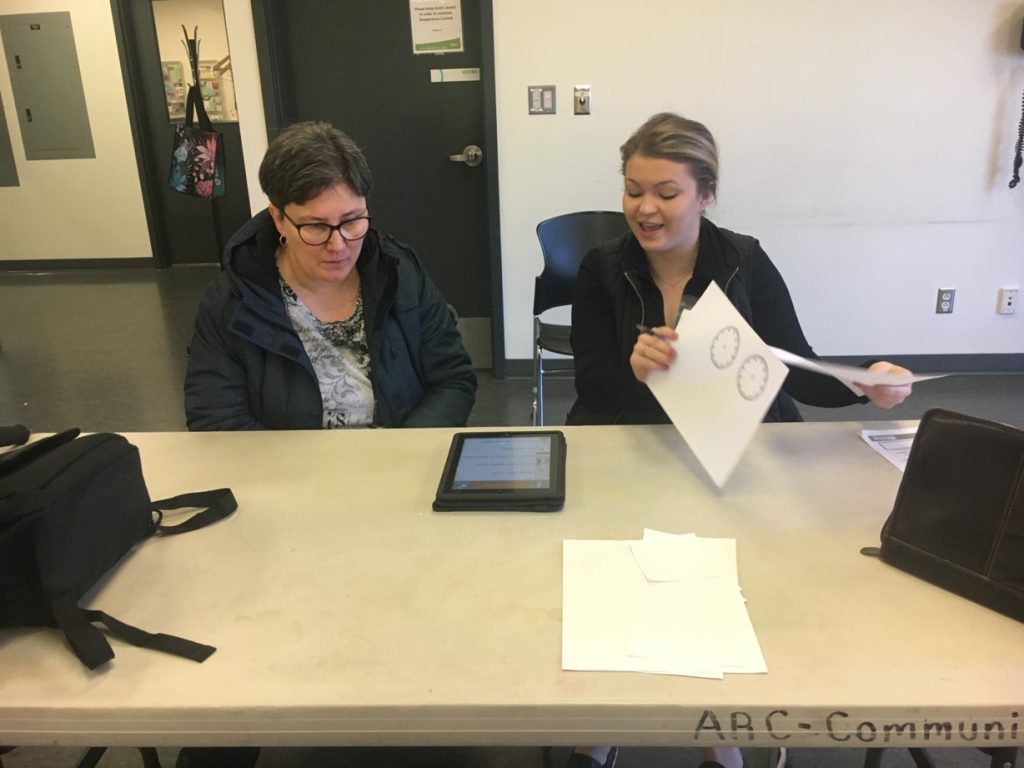
Stroke survivor, Sherre and volunteer, Emily use a tablet for activities to help improve Sherre’s cognition and language at the Abbotsford Stroke Recovery Program.
Every year, about 6,500 British Columbians have a stroke. Around 75% of them are over the age of 65. A stroke survivor may spend days or weeks in acute care, and then days, weeks or months in rehabilitation whether as an inpatient, an outpatient, in a community-based setting, or some combination of those. This is just the beginning of the recovery journey.
Stroke survivors, who may be living with effects of stroke like physical disability, cognitive challenges, and emotional difficulties such as depression, have potential to recover and see improvements – both in function and quality of life – for the rest of their lives.
Life after stroke
The Stroke Recovery Association of BC, based in Vancouver, delivers community-based programming and service throughout B.C., designed to support stroke survivors in reaching their personal goals for recovery and community reintegration. In other words, getting back to “life after stroke”.
The non-profit is proud of the work they’ve done, but wanted to improve, so they enrolled in the Project Impact – Healthy Aging program offered annually through Healthy Aging by United Way. The program increases a non-profit’s ability to improve their work in community by focusing on how they develop and evaluate their programs.
“The resilience and dedication of stroke survivors to work hard on their recovery…it is inspiring, and a reason to work hard every day to provide and improve our programs,” says Janneke Vissers, Regional Coordinator at the Stroke Recovery Association.
There were several ah-ha moments for the association as they evaluated their work.
“There are really two key elements to our stroke recovery programs. Number one is educating stroke survivors about neuroplasticity, and using goal-setting to improve and accelerate recovery outcomes” says Janneke.
“Number two is the power of peer support and belonging to a community. All the people that we’ve interviewed emphasized that without the support of their peers, they still would have felt lost, alone, and wouldn’t know where to go. It is very inspiring that many people grew from a stroke victim to a stroke survivor and became a role model to other stroke survivors.”
Working to improve

These findings are among the results coming out of Project Impact – Healthy Aging. Janneke and her colleague, Jill Jukes presented their findings at the Project Impact Healthy Aging virtual showcase June 4 via Zoom. The Stroke Recovery Association, and eight other B.C. programs aimed at helping seniors, shared their findings at the virtual event.
Proving the impact programs are having on seniors’ lives is critical according to Dr. Steve Patty, who leads Project Impact programs throughout the U.S. and Canada.
“We can’t simply point to anecdotes, numbers of participants, program satisfaction rates, or other measures of our efforts as indicators of progress. We need solid evidence that we are making the difference we claim to make,” Steve says. “We need …to improve ourselves in service to the cause of our organizations and the health and vitality of our seniors.”
Changing programs, improving lives
“When we were analyzing our data, we realized that the benefits of our stroke recovery programs are huge. At the same time, we realized that there are so many people who cannot access our programs and so we decided to do more,” says Janneke.
“Ironically, COVID-19 has offered us an opportunity to reach out to a much larger audience by offering our programs online. It has also helped us to extend our networks. Apart from the fact that we want to improve our programs, we also think about all those stroke survivors that can’t log on to Zoom. We’re making it our priority to come up with innovative ways to do more, do better, and empower more people.”
To view more 2020 Project Impact – Healthy Aging presentations, click here.
Along with the Project Impact event, Healthy Aging by United Way celebrated B.C. Seniors Week, June 1-8, by profiling seniors and programs whose lives have been changed thanks to provincial Community-Based Seniors’ Services sector initiatives that support healthy and happy aging. Visit our Facebook and Instagram channels to see more local love in action across our province.
Project Impact Healthy Aging is offered by Dr. Steve Patty of Dialogues in Action and funded by B.C.’s Ministry of Health.
Topics : Building strong communities, Healthy Aging, Local love, Seniors

